Last October, Japan welcomed its first female Prime Minister in the nation’s history. Prime Minister Sanae Takaichi dissolved the House of Representatives only a few months into her term, stating that she wanted to ‘secure a clear mandate from the people.’ As a result, a general election for the House of Representatives was held on 8 February 2026.
The National Diet of Japan is a two-house parliament, as is the case in Australia. The upper house, the House of Councillors (Sangiin), corresponds to the Australian Senate, while the lower House of Representatives (Shugiin), serves a similar role to Australia’s House of Representatives. The government is formed by the party that holds a majority in the lower house, like Australia. The terms of the two houses are six years and four years respectively, but the lower house is often dissolved by the Prime Minister, who, like in Australia, is chosen from the lower house. As a result, elections are usually held every two to three years.
In the recent election, the Liberal Democratic Party (LDP) increased its number of seats significantly and is said to have achieved its largest victory since its founding in 1955. Of the 465 seats in the House of Representatives, the LDP won 316 seats on its own. Combined with its coalition partner, the Japan Innovation Party (JIP), the total rose to 352 seats. As a result, the LDP alone secured more than a two-thirds majority in the House of Representatives (with two-thirds equivalent to 310 seats).

In Japan, a bill generally must be approved by both houses in order to become law. However, if the House of Representatives approves the bill with a more than two-thirds majority, it can pass the bill again even if the House of Councillors rejected it, allowing the bill to be enacted. At present, neither the LDP alone nor the governing coalition of the LDP and JIP holds a majority in the House of Councillors. For this reason, the fact that the LDP by itself secured more than a two-thirds majority in the House of Representatives is of great significance to the Takaichi administration. Close attention will be paid to how the administration proceeds from here in the months ahead.

Since 1984, Campbelltown and Koshigaya have maintained a strong and active sister city relationship. Except during the COVID-19 pandemic, at least one, sometimes 2, student delegations have travelled between the two cities each year.
During COVID-19, the student exchanges moved online, allowing students from Campbelltown and Koshigaya to meet virtually, discuss and ask questions about common areas of interest.
Delegation visits of Sister City Association members from both cities have been organised every few years to bring the two Sister City Associations and their councils together.
Outbound students
Each year, around April, the Campbelltown- Koshigaya Sister Cities Association (www.cksca.org.au) promotes its annual student delegation trip to all 16 high schools in the local government area. The Association seeks applications from students aged 14 to 18 who wish to travel to Japan during the September school holidays.
Fifteen students are selected following the interview process. President Terry Crotty explained that the Association receives 40 or more applications each year, which means “we have the unfortunate task of telling many students that they haven’t been selected. However, we encourage all unsuccessful applicants to reapply in the following year. In many years, up to 6 students are selected from those who were unsuccessful previously. That year of personal growth really shows through at the interview”.
Two adult leaders are also selected to accompany and guide the group throughout the trip.
The selected students and their parents or guardians attend their first group session, a parent information evening, where they meet other students in the delegation. They receive details about the trip, including costs, schedule and host family accommodation, and have the opportunity to ask any questions about both the preparation and the trip itself.
The group then comes together for orientation sessions, held over 8 Friday evenings. These sessions help students to bond, learn basic conversational Japanese, and understand what to expect on the trip. They also gain insights into Japanese customs and etiquette, practice using chopsticks and develop and rehearse a performance to be presented several times during their visit to Japan.
Prior to their departure, the student delegation attends a civic reception to see them off. At the event, the students receive words of encouragement from the mayor and representatives of the Campbelltown-Koshigaya Sister Cities Association, and also present the performance they will deliver during their time in Japan.
The performance showcases distinctly Australian elements such as Australian football, meat pies, kangaroos, Holden cars, as well as Australian songs such as ‘Waltzing Matilda’. The show also highlights Australia’s rich ethnic diversity and multicultural coexistence, reflected not only in its themes but also in the students who embody that diversity on stage.
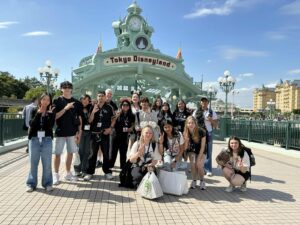
Upon arrival in Japan, the delegation is welcomed to Koshigaya at an official ceremony. The students visit sights in and around Koshigaya, including local schools, take day trips to Nikko and Tokyo Disneyland, as well as an overnight trip to the Hakone / Mt Fuji area.
Online learning
The Association offers online training resources to support the group’s preparation. Students study the content and complete assessments at the end of each module. Modules include learning about Koshigaya City, Japanese culture, language and etiquette, including shoe removal, the use of chopsticks and bathing practices. If you require any further information about these resources, please email secretary@cksca.org.au.
During the trip, parents and friends can see photos each day on a dedicated Facebook site set up for each delegation.
When the group returns to Campbelltown after their 12-day visit to Japan, they reflect on their experiences at a storytelling evening soon after their return.
Inbound students from Koshigaya
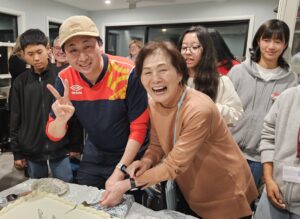
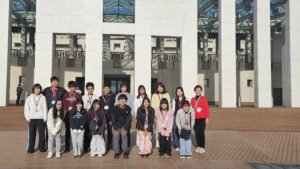
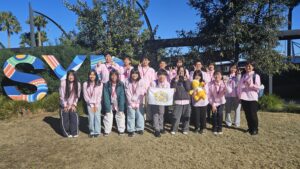
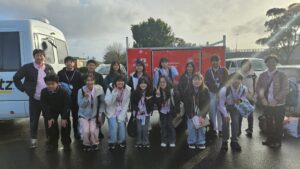
Each year, around the end of July, a group of 15 students and 2 leaders arrive from Koshigaya for a 10-day stay in Campbelltown. Host families accommodate each student and leader. The program includes an overnight stay in Canberra, as well as day trips to Manly, Bondi, the Blue Mountains, and various attractions around the Campbelltown and Macarthur region. Of course, there is also plenty of time for the students to go shopping.
Each day, the host families bring their students to the meeting point at around 8 am. The group then boards the bus for a fun-filled day. Around 6 pm, the host families collect their student and provide dinner and evening activities.
Annual awards for students studying Japanese
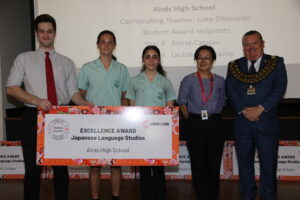
Each year, in early December, the Association holds an event to recognise the achievements of students studying Japanese at 7 high schools in the Campbelltown local government area.
Award recipients not only demonstrate strong academic results but also engage in broader extra-curricular activities to deepen their understanding of Japanese language and culture.
Awards are presented to students in Years 8 and 9, and to students in Year 11. School principals and language coordinators attend to explain why each student has received their award.
Family and friends of the award recipients also attend to share the celebration.

40th anniversary
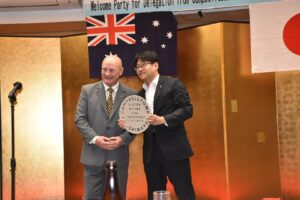
In 2024, the Sister City relationship between Campbelltown and Koshigaya celebrated its 40th anniversary.
Council and Association representatives visited each city to mark the milestone and reaffirm their commitment to continuing the long-standing and successful relationship.
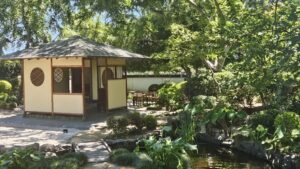
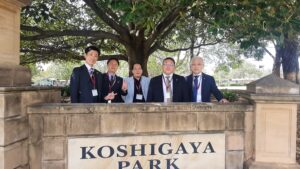
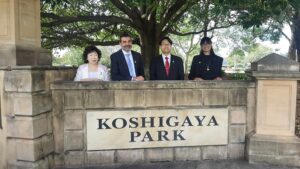
Campbelltown welcomed the anniversary delegations to Koshigaya Park, named 40 years ago at the beginning of the Sister City relationship. The group also held an event at the Campbelltown Arts Centre Japanese Garden, which houses an authentic tea house, gifted by Koshigaya City.
Similarly, Campbelltown delegations were welcomed at Campbelltown Park in Koshigaya.
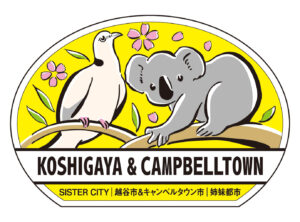
To commemorate 40 years of the Sister City relationship, a special logo was designed for the anniversary.
Conclusion
President Terry Crotty said the long-standing success of the relationship with Koshigaya has been the result of the strong support of the councils in Campbelltown and Koshigaya, as well as the dedication of Association members in both cities who generously volunteer their time.
For more information about any aspect of the Campbelltown-Koshigaya Sister City relationship, please email secretary@cksca.org.au
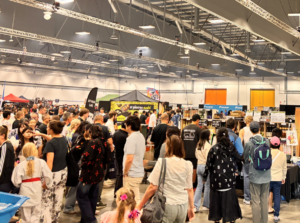
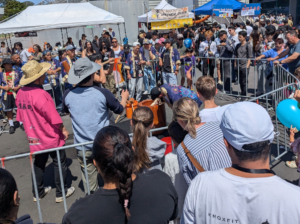
Japan Day 2026 took place in Auckland on 22 February 2026, marking the event’s 22nd anniversary.
The venue was buzzing with excitement, featuring a wide variety of attractions from Japanese food stalls, a Hina doll and Mikoshi (portable Shinto shrine) display, to hands-on cultural experiences such as tea ceremonies and calligraphy. The stage performances added to the energy, with dynamic shows including Yosakoi dance (a lively modern Japanese folk dance), Aikido (Japanese martial arts), and Iaido (Japanese swordsmanship).
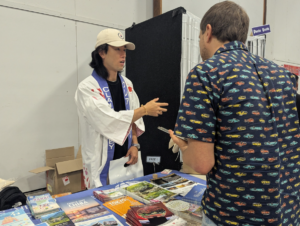
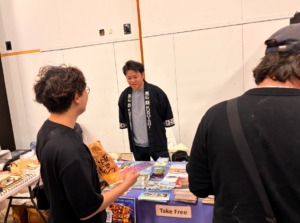
CLAIR Sydney hosted a booth showcasing the unique attractions and cultural highlights of regions across Japan. Using brochures and maps provided by local governments, we introduced visitors to a wide range of destinations beyond Tokyo and Kyoto.
Many visitors expressed strong interest in regional Japan and traditional culture, asking questions such as “Which regions do you recommend besides Tokyo and Kyoto?”, “Where can we see historic buildings and experience traditional culture?”, and “When and where is the best time to see cherry blossoms?”
Our team engaged with each visitor individually, listening to their interests and providing tailored information on Japan’s scenic landscapes, cultural heritage, and hands-on experiences.
CLAIR Sydney will continue to promote regional Japan to audiences in Australia and New Zealand through events like this, strengthening awareness of the country’s diverse local cultures.
Thank you very much to everyone who visited our booth!
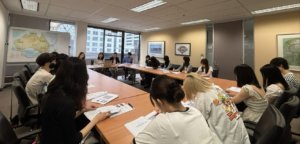
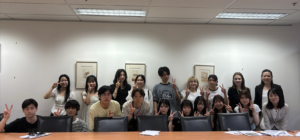
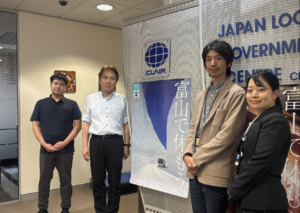
On 20 February, 16 students from the Department of Child Study, Faculty of Economics, and Department of Intercultural Studies at Kanazawa Seiryo University in Ishikawa Prefecture visited the CLAIR Sydney Office as part of their overseas study program.
Our office provided a briefing on Australia that covered key facts such as its land area, population, and economy, the historical development of Australia as a multicultural nation, recent trends in outbound travel from Australia to Japan, and an overview of the country’s education and childcare systems.
The students asked a wide range of questions, including differences in working styles between Australia and Japan and the foreign languages (other than English) that Australian children learn in primary school. Their enthusiasm for learning left a strong impression on us.
Following their visit, the students travelled to Melbourne to observe a local primary school. We sincerely hope that their time in Australia, including their visit to our office and the school, was both rewarding and meaningful.

Commemorative Events for the 45th Anniversary of the Sister City Relationship between Tomakomai City and Napier City
On 20 November 2025, a cultural welcome ceremony and gala dinner party were held to mark the 45th anniversary of the sister-city relationship between Tomakomai City, Hokkaido, Japan, and Napier City, New Zealand.
The official visit program is conducted every five years; however, the 40th-anniversary program was cancelled due to the COVID-19 pandemic. As a result, this visit marked the first occasion in ten years that a delegation from Tomakomai travelled to Napier.
The primary objectives of this visit were to promote cultural exchange between the Māori people of New Zealand and the Ainu people of Hokkaido, as well as encourage economic exchange amongst business stakeholders, with the aim of rebuilding connections that have weakened over time.
Cultural Welcome Ceremony

At 9:00 a.m. on 20 November, the Tomakomai delegation participated in a pōwhiri, a traditional Māori welcoming ceremony, at Waiohiki Marae.
Upon arrival at the venue, the delegation was welcomed by the Mayor of Napier, Richard McGrath, who exchanged greetings and handshakes with Mayor Kanazawa of Tomakomai and other members of the delegation. During the ceremony, Māori representatives from the marae and local children, performed a haka, followed by formal speeches known as whaikōrero, delivered in te reo Māori.
At the conclusion of the ceremony, participants exchanged hongi, a traditional greeting involving the gentle touching of noses, along with hugs, creating a warm and friendly atmosphere that reflected mutual respect and openness.
Following the ceremony, an introduction to Māori culture and history was provided by representatives of Napier, offering the Tomakomai delegation a valuable opportunity to deepen their understanding of local cultural traditions.
Gala Dinner Party
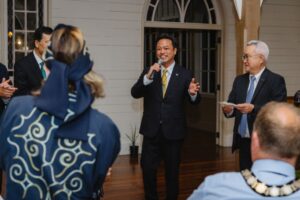
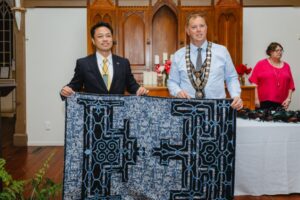
The commemorative ceremony was attended by the Tomakomai delegation, consisting mainly of local government representatives, Ainu-related organisations, and business leaders, alongside members of the Napier City Council. Representatives from Pan Pac Forest Products Ltd (a joint venture between Oji Paper and a local timber company in Napier, which marked the beginning of this exchange), Oji Holdings Corporation, the Embassy of Japan in New Zealand and the CLAIR Sydney office were also in attendance.
The program included speeches by representatives from both cities, an exchange of commemorative gifts, and cultural performances by members of the Ainu community, making the event both meaningful and diverse in content.
During the gift exchange, Napier City presented Tomakomai City with a wall hanging made from native New Zealand plants, while Tomakomai City presented Napier City with a tapestry featuring traditional Ainu motifs.
In his address, the Mayor of Tomakomai expressed a strong desire to further develop exchanges between the two cities in preparation for the 50th anniversary in five years’ time. He also conveyed expectations were expressed for expanded cooperation across a range of fields, including cultural, economic, and educational exchanges.
At the conclusion of the ceremony, all participants from Japan performed the song Ue o Muite Arukō (internationally known as Sukiyaki). The performance fostered a strong sense of unity and mutual respect, leaving the venue filled with an atmosphere of cultural appreciation and shared goodwill.
Tomakomai City and Napier City plan to continue regular communication in order to further strengthen their relationship. In addition to online interactions, the resumption of youth-focused exchanges, such as student exchange programs, is currently under consideration. The continued development of exchange between the two cities is highly anticipated.